
Quick Summary
This blog explains why more restaurants now use their own restaurant online ordering system instead of relying only on Zomato or Swiggy. It covers market growth, commission savings, kitchen integration, and how direct orders build customer relationships. Written in simple language for restaurant owners.
Table Of Contents
Introduction
When customers are nowadays looking for convenience, even when it comes to ordering and getting food to their doorstep, it is now become essential for every restaurant to offer digital ordering options. Many restaurant owners however continue to rely heavily on third-party apps that charge high commissions on every order. This leaves less profit despite increased sales. In this blog post, we examine the current market for restaurant online ordering system solutions, why direct ordering is gaining traction, and how restaurant owners can reduce costs while maintaining smooth kitchen operations.
Key Takeaways
Third-party apps charge 25-30% commission on every order.
Direct online ordering lets you keep more profit per dish.
Consolidated systems reduce kitchen errors and tablet clutter.
Owning customer data helps build repeat business.
Modern ordering systems are affordable and easy to set up.
Current Market Size and Growth Projections for Restaurant Ordering Technology
With convenience becoming the most important thing customers look for, digital channels now account for nearly 35% of total restaurant revenue in India. This number continues to rise each year. More customers now prefer ordering directly from restaurant websites or apps because it is often cheaper and faster than dining out.
So now, the adoption of online ordering system for restaurants is highest among quick service restaurants, where speed matters most, and the casual dining chains are catching up steadily. Ghost kitchens operate entirely on digital orders and depend completely on restaurant ordering technology to function. This shift is not temporary and shows clear long-term growth potential for the industry.
Restaurants Are Moving from Third-Party Apps to Direct Ordering
Restaurants, whether they are small or chain restaurants, they are now shifting away from third-party apps for a few clear reasons. Commission fees on these platforms typically range from 25 to 30 percent per order. Operating your own restaurant online ordering and food delivery system costs significantly less and leaves more profit per dish, where there is also the issue of customer data.
When orders come through apps, the restaurant never sees who the customer is or how to reach them. Without this information, building repeat business becomes difficult. Menu presentation is another factor. Having your own platforms gives you complete control over item details, images, and prices, because the aggregators usually standardize or hide this information.
Check out some Restaurant Management Tips.
How a Restaurant POS System Integrates with Online Ordering
When you choose to implement the right and the best suitable system for your restaurant, the connection between your online ordering website and the kitchen must work without interruption.
Orders must flow seamlessly from website to kitchen
When a customer places an order on your website, it should appear inside your kitchen display or printer automatically. No one should have to type it again. This removes delays and ensures preparation starts immediately. A restaurant pos system handles this transfer smoothly when properly configured.
Manual order entry errors and delayed tickets
Typing orders manually from a tablet or paper slip into the system leads to mistakes. Wrong items, incorrect modifiers, or forgotten dishes upset customers and cost money. These errors also slow down kitchen staff who wait for corrected tickets. This is a common frustration in restaurants without proper integration.
Centralized system for all order sources
Your restaurant receives orders from dine-in customers, your website, and delivery apps. Managing them separately creates confusion. A single order management software consolidates everything into one screen. Staff see all orders in the same format regardless of source. This reduces training time and prevents orders from getting missed.
This is the Best Restaurant Inventory Management Software.
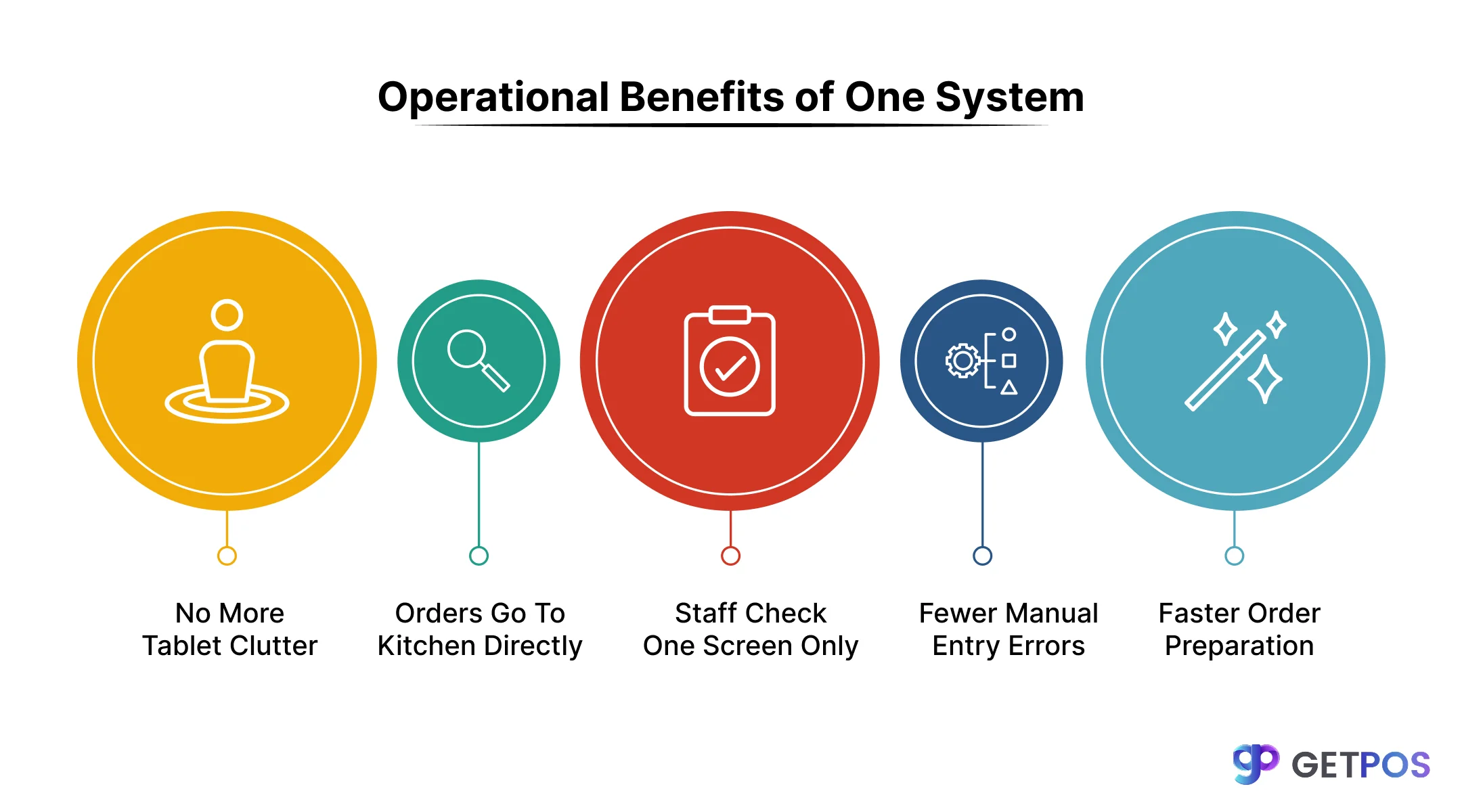
Operational Benefits of Consolidating Orders into One System
Restaurant owners can benefit when all orders flow into a single place instead of multiple devices. Many kitchens currently keep separate tablets for different platforms, and their own website. Staff must check each screen constantly, and still orders sometimes go unnoticed when screens dim or printers jam.
Using one order management software eliminates this clutter. All orders appear in the same format on one display. Kitchen staff see dine-in, delivery, and pickup tickets together. This also reduces miscommunication. Waiters do not have to shout orders or stick paper slips on walls. The restaurant pos system sends everything directly to the kitchen.
This is How GETPOS Supports multi-location businesses.
Conclusion
Running a restaurant today requires more than good food. Customers expect to order online easily and receive accurate orders on time. Relying only on third-party apps eats into your profits and keeps you from knowing your own customers. Shifting to your own online ordering setup puts you back in control. You keep more money from every order and build a list of customers you can reach directly. GETPOS offers a complete system that connects your website orders directly to your kitchen. There is no need for multiple tablets or manual entry. Everything works from one place, the way it should.
Frequently Asked Questions
Third-party apps typically charge 25 to 30 percent commission on every order. This significantly reduces profit margins compared to orders placed through your own system.
Yes. A restaurant online ordering system lets customers order directly from your website. You pay only a small fixed monthly fee and no per-order commission.
Modern restaurant pos systems are designed to be simple. Most staff learn the basics within one shift because the interface is similar to what they already use.
Orders placed on your website go directly to your kitchen display system or printer. No one has to type them manually, which eliminates errors.
Consider real-time stock tracking, low inventory notification, particular reporting, and ease of integration.